
The Complete Guide to Financing a 2–4 Unit Property
Build Wealth While You Live There
If you've been thinking about buying your first home, you may be overlooking one of the best opportunities available: a 2–4 unit property.
Whether it's a two-flat in Chicago, a duplex in the suburbs, or a four-unit building in another market, buying a multi-unit property can help you become a homeowner while building long-term wealth.
One of my favorite strategies for first-time buyers is purchasing a 2–4 unit property. With a relatively low down payment, you can live in one unit while rental income from the others helps offset your monthly housing payment. A few years down the road, when you're ready for your next home, you can move out and keep the property as an income-producing asset.
Instead of simply buying your first home, you're building the foundation for your future.
Why Buy a Multi-Unit Property?
A multi-unit property allows you to:
Live in one unit while renting the others.
Use rental income to help qualify for the mortgage.
Build equity as the property appreciates.
Create an additional monthly income stream.
Own an investment property sooner than many people think.
It's one of the few opportunities where your tenants can help pay down your mortgage while you build wealth over time.
Primary Residence vs. Investment Property
This is the first question I ask every client.
Will you be living in one of the units?
If yes, lenders consider it your primary residence, which comes with significantly better financing options.
If no, it's considered an investment property, which generally requires a larger down payment and has stricter qualification guidelines.
For many buyers, living in the property for a few years before moving on is the smartest financial strategy.
How Much Do You Need for a Down Payment?
The answer depends on the loan program.
FHA
As little as 3.5% down
Available on 1–4 unit owner-occupied properties
Great option for buyers with limited savings
3-4 units 3 months reserves of the total mortgage payment (this is money you have left over after down payment & closing costs. Can be 401k etc)
Conventional
As little as 5% down on owner-occupied 2–4 unit properties (for qualified borrowers)
Often a good fit for buyers with stronger credit
6 months reserve of the total mortgage payment(this is money you have left over after down payment & closing costs. Can be 401k etc)
Portfolio Loans
Some portfolio lenders offer financing with flexible underwriting guidelines. Down payment requirements vary depending on the borrower, property, and lender.
Can Rental Income Help You Qualify?
Yes—and this is one of the biggest advantages of buying a multi-unit property.
Lenders can often use a portion of the expected rental income from the other units to help offset the monthly housing payment and strengthen your qualification.
For many buyers, this can make the difference between qualifying for a single-family home and qualifying for a property that also generates income.
Does the Number of Units Matter?
Absolutely.
A two-unit property has different financing requirements than a three- or four-unit property.
Depending on the loan program, larger properties may require:
Additional cash reserves
Higher loan limits
Additional underwriting requirements
Self-sufficiency calculations for certain FHA loans
This is why it's important to work with a lender who understands multi-unit financing—not every lender handles these loans regularly.
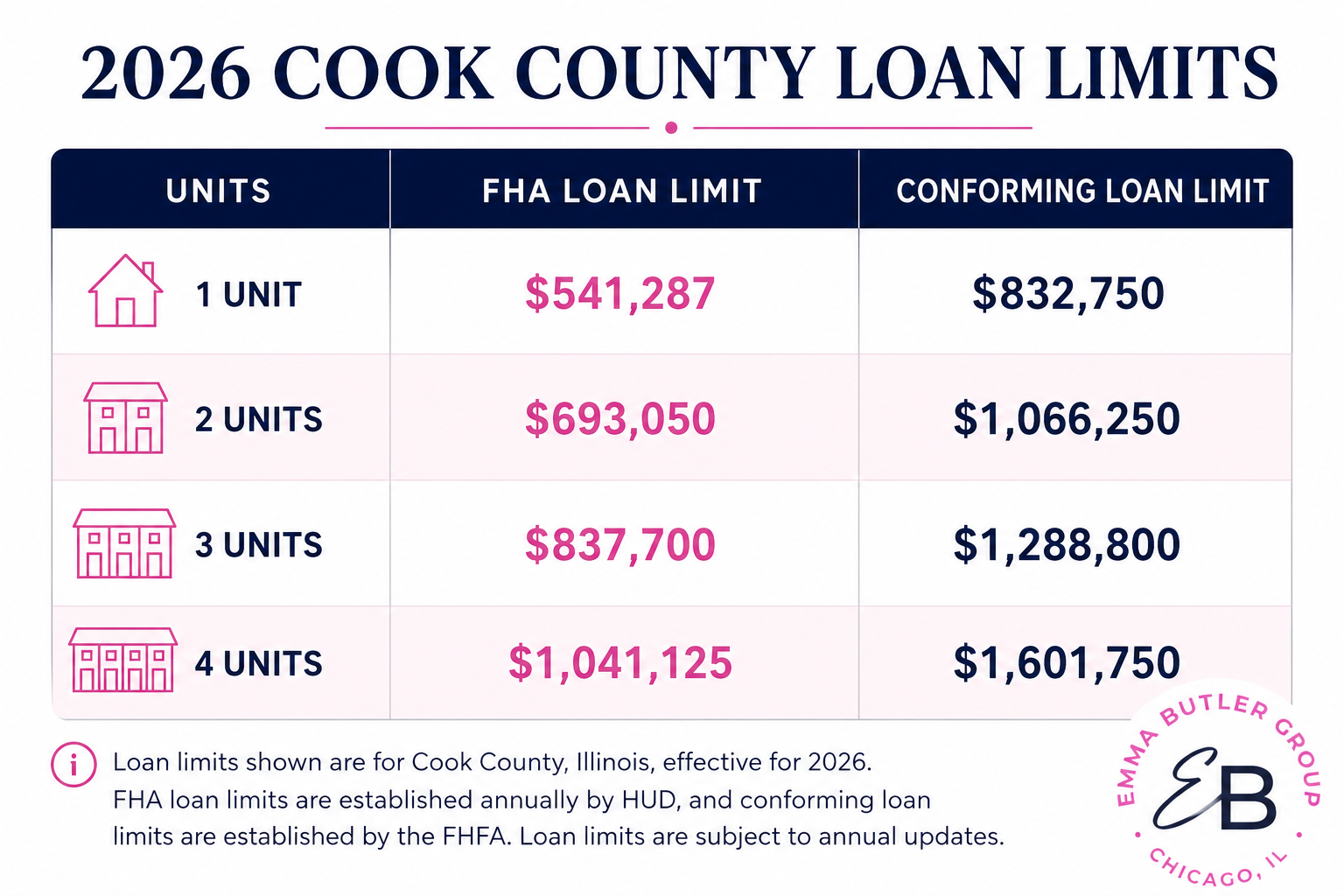
Understanding Loan Limits
Loan limits increase as the number of units increases.
That means you can often finance a significantly larger purchase on a four-unit property than you could on a single-family home.
Because these limits are updated periodically and vary by location, your lender should review the current limits for your county before you begin shopping.
2026 Cook County Loan Limits
Buying the Right Property
Not every building qualifies for residential financing.
One of the biggest mistakes I see is buyers falling in love with a property before confirming it's legally configured.
A property must contain legal residential units. Illegal basement apartments or non-conforming units generally cannot be counted when qualifying for financing, and their rental income often can't be used either.
If a building has five or more legal residential units, it is typically financed as a commercial property rather than a residential mortgage.
What About Closing Costs and Interest Rates?
Closing costs are generally similar to purchasing a single-family home.
Interest rates on multi-unit properties are often slightly higher than those for comparable single-family homes, but the ability to generate rental income frequently outweighs that difference.
The focus shouldn't just be today's payment—it should be the long-term return on the investment.
Is a Multi-Unit Property Right for You?
A multi-unit property may be an excellent choice if you:
Are buying your first home.
Want help covering your monthly mortgage.
Are interested in building long-term wealth.
Plan to own rental property in the future.
Like the idea of creating passive income over time.
It isn't the right fit for everyone, but for the right buyer, it can be one of the smartest financial decisions they'll ever make.
Emma's Advice
Don't think of it as buying your first home. Think of it as buying your first asset.
Many of my clients who purchased a two-flat or three-flat years ago now own multiple properties or have a rental property helping fund their retirement.
Real estate has a unique ability to build wealth over time, and a multi-unit property is often one of the best ways to get started.
Final Thoughts
Buying a 2–4 unit property isn't just about becoming a homeowner—it's about creating opportunities for your future.
With the right financing strategy and guidance, you may be able to purchase a property with a relatively small down payment, reduce your monthly housing costs through rental income, and begin building a real estate portfolio one property at a time.
If you're wondering whether a multi-unit property is right for you, I'd be happy to walk through your options and help you build a strategy that fits your goals.
