
When you're shopping for a mortgage, you'll often hear lenders talk about points.
You might hear something like, “Your rate is 6.25% with one point.”
But what does that actually mean? And more importantly, is paying that point worth it?
I always encourage my clients to look at the bigger picture. It's not just about getting the lowest interest rate. It's about what you're paying to get that rate, whether you're comfortable with the monthly payment, and how long it will take to recover the upfront cost.
Sometimes paying points makes sense. Other times, I'd much rather see you keep that money in your bank account.
First, What Are Mortgage Points?
Not All Mortgage Points Are the Same
Here's something many buyers don't realize: when you see points on a mortgage quote, they aren't always there because you've chosen to buy down your interest rate.
There are different types of mortgage pricing costs.
Loan-Level Price Adjustments (LLPAs) are pricing adjustments used on conventional loans backed by Fannie Mae and Freddie Mac. They're based on factors such as your credit score, down payment, whether you're buying a primary residence or investment property, and the type of property.
These adjustments affect the pricing of your mortgage and may be reflected in your interest rate, upfront costs, or both.
Discount points, on the other hand, are an upfront cost paid specifically to obtain a lower interest rate.
Both can affect what your mortgage costs, but they serve different purposes.
That's why I encourage buyers to ask their lender to explain any points or fees they're being charged.
Are these costs part of the loan's pricing, or am I paying extra to get a lower interest rate?
Understanding that difference makes it much easier to compare mortgage options.
Mortgage discount points are fees you pay upfront to get a lower interest rate on your mortgage.
One point equals 1% of your loan amount.
For example, if you're borrowing $400,000:
1 point costs $4,000.
Half a point costs $2,000.
2 points cost $8,000.
These fees are generally paid at closing.
In exchange, the lender offers you a lower interest rate, reducing your monthly principal and interest payment.
One thing to understand: Paying one point doesn't automatically lower your interest rate by 0.25%. The actual reduction depends on the lender, loan program, and mortgage pricing at that time.
Also, not every fee expressed as a percentage of your loan amount is necessarily a discount point. It's important to understand exactly what you're being charged.
When a Lender Quotes You a Rate, Ask What It Costs
This is something I think every homebuyer should understand.
Two lenders might both quote you a 6.25% interest rate, but one could be charging a point while the other isn't.
On a $400,000 mortgage, that's a $4,000 difference in upfront costs!
So don't just ask:
“What's your interest rate?”
Ask:
“What's the interest rate, and what does it cost to get that rate?”
And don't forget to compare the other lender fees and Annual Percentage Rate (APR), which helps reflect certain borrowing costs beyond the interest rate itself.
How Long Will It Take to Recover the Cost?
Let's look at a simple example.
You're borrowing $400,000 on a 30-year fixed mortgage and have two options:
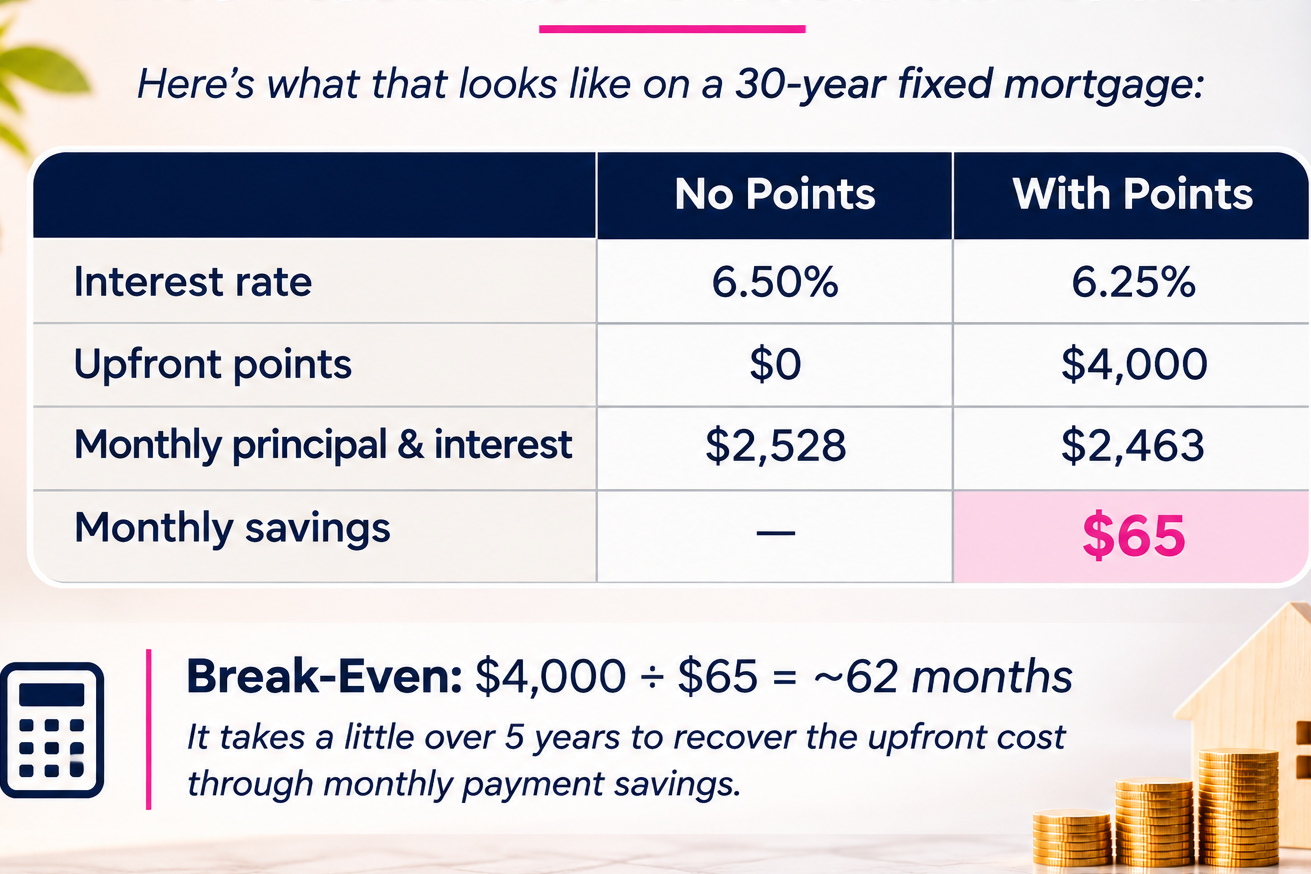
Illustrative example, not a current rate quote. Assumes a $400,000 loan amortized over 360 months. Property taxes, homeowners insurance, mortgage insurance, and HOA fees, if applicable, are additional and assumed unchanged between options.
You're paying $4,000 upfront to save approximately $65 per month.
$4,000 ÷ $65 = approximately 62 months.
That's a little over five years to recover the cost through monthly payment savings.
Now ask yourself: will you keep this mortgage for at least five years?
If you refinance or sell the home after two years, you won't have recovered the full cost through monthly savings.
This is a simplified break-even calculation. A more detailed comparison can also account for differences in principal repayment, the time value of money, and potential tax considerations.
How Long Will You Be in the Home?
This is one of the first questions I ask my clients.
Are you purchasing your forever home? Or do you think you'll move in three to five years?
If you're planning to sell relatively soon, spending thousands of dollars to lower your interest rate might not make sense.
But there's another consideration.
How long you own the home and how long you keep the mortgage aren't necessarily the same thing.
You could plan to live in the property for 15 years but refinance your mortgage after two.
That's why I want to look at both your short-term and long-term plans before recommending paying points.
What If Mortgage Rates Come Down in the Next 6–12 Months?
This is another important part of the conversation.
Do we think mortgage rates could be lower six months or a year from now?
Nobody knows for certain. Rates can move in either direction, and refinancing isn't guaranteed.
But if there's a reasonable possibility that you'll refinance before recovering the cost of the points, is spending that money today the best decision?
Maybe not.
On the other hand, you also need to be comfortable keeping your current mortgage rate long term.
I never want someone purchasing a home with the assumption that they'll have to refinance in order to afford the payment.
If rates come down and refinancing makes financial sense, great! That's an opportunity.
But if rates don't come down, you should still be comfortable with your mortgage payment.
What If the Seller Is Paying for the Points?
Now this can change the conversation.
Let's say you negotiate a $10,000 seller credit toward your closing costs.
You may be able to use some of that money to pay discount points and lower your interest rate.
That's certainly attractive because the seller is contributing toward the cost.
But I still want to look at your options.
Could you use that $10,000 toward your other closing costs instead?
Would that allow you to keep more money in your savings account?
Or is reducing your monthly mortgage payment more important?
Even when the seller is paying, I want to make sure we're using that credit in the way that benefits you most.
Seller credits are subject to loan-program limits and allowable closing costs. They're also part of the overall purchase negotiation, so they're not necessarily free money.
So, Should You Pay Points?
There's no one-size-fits-all answer.
I generally want to consider four things:
How long will you keep the mortgage? Will you have enough time to recover the upfront cost?
Are you comfortable with the payment? Both today and if rates don't decrease.
Could you refinance in the near future? If so, will you recover the points before replacing the loan?
Where is the money coming from? Is it your own savings or a seller credit that could be used toward other closing costs?
Sometimes paying points is a smart long-term decision.
Sometimes paying a slightly higher rate and keeping more money in your account is the better option.
My Advice: Look at Both the Short Term and Long Term
When I'm reviewing mortgage options with clients, I don't want to just give them an interest rate.
I want to show them what that rate costs, how it affects the monthly payment, and how long it takes to recover any upfront expense.
Then we can look at different scenarios.
What if you refinance in two years? What if you stay in the mortgage for ten years? What if rates don't come down?
The goal isn't to get the lowest interest rate at any cost. It's to make the best financial decision for your situation.
If you're buying a home or comparing mortgage options, let's review the numbers together and figure out what makes the most sense for you.
Emma Butler
The Emma Butler Group at Neighborhood Loans
www.emmabutlergroup.com
